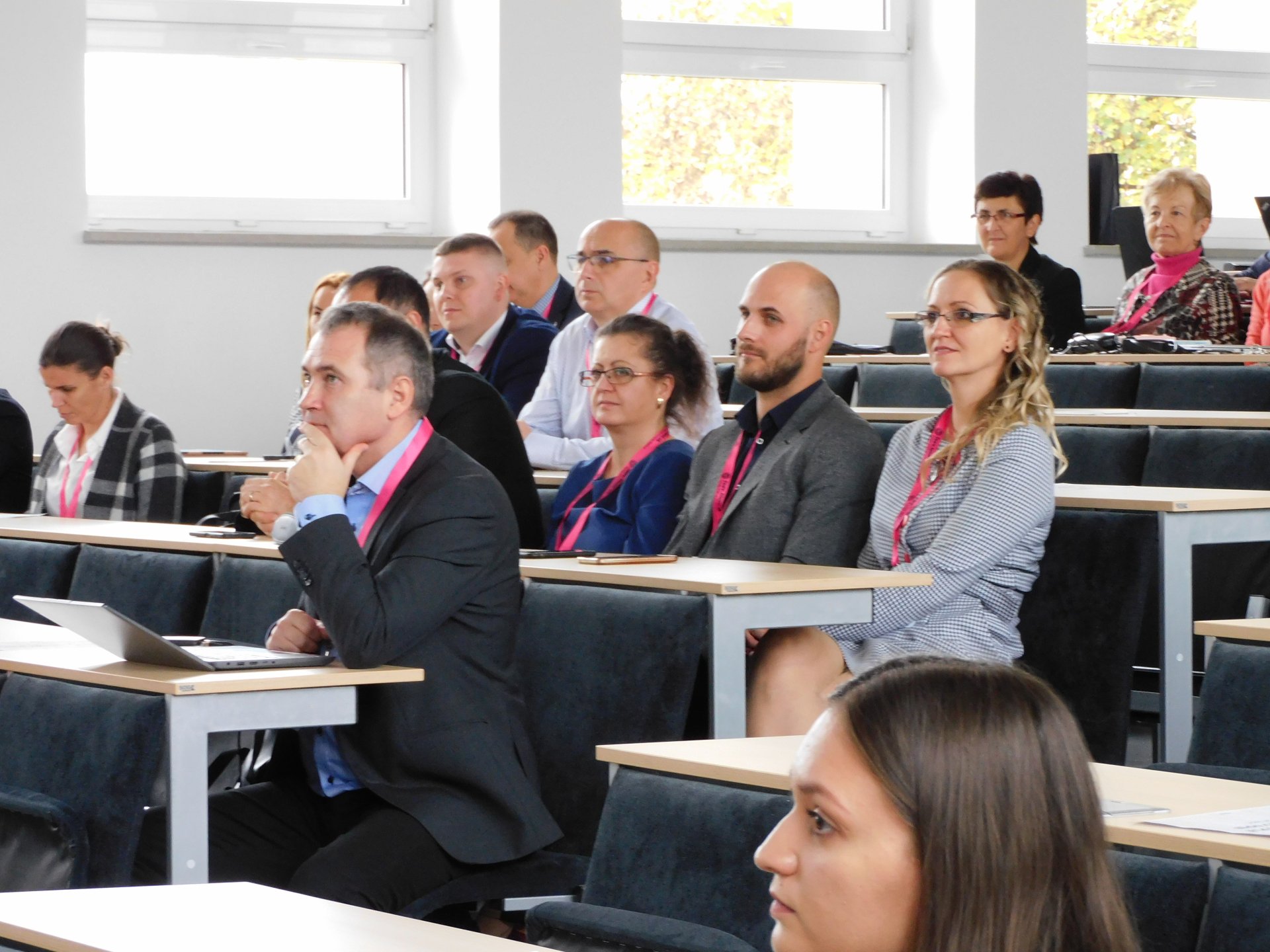
Invited scientific-research lectures are complemented by inspiring presentations from leading experts in practice.
An open dialogue between two personalities guided by a moderator, bringing different perspectives, experiences and insights on current topics.
A space for connecting entrepreneurs, professionals and other participants with the aim of establishing new contacts, finding opportunities for cooperation and creating new professional partnerships.
Presentation of the latest research results of PhD students and young scientists in an international context.
Interesting topics processed through collaboration that brings new ideas and creative energy.
FSEVco 2026 – Trends in Business and Human Resource Management is an international scientific conference distinguished by its active connection between academia and business and professional practice. It brings together researchers, university lecturers, entrepreneurs, HR professionals, lawyers, managers, experts in digitalisation and AI, as well as representatives of the public sector.
The 3rd edition of the conference addresses current topics in human resource management, leadership, business, law, digitalisation and artificial intelligence. Particular emphasis is placed on ensuring that scientific knowledge does not remain confined to the academic environment, but finds practical application in the day-to-day operation of organisations, businesses and public institutions.
The conference creates an environment where research findings meet real-world experience and practice. Expert presentations, discussions, workshops and networking provide opportunities to connect academic knowledge with market needs, share examples of good practice, and jointly seek solutions to current challenges related to people, technology and business.
In growing environmental, social, and economic challenges, applying ESG commitments is becoming crucial even for SMEs. The scientific research project aims to develop two comprehensive conceptual frameworks for ESG-oriented leadership, considering the differences between manufacturing SMEs and service-oriented SMEs, which will define components of ESG-oriented leadership, related HRD processes, and sustainable SME performance.
To achieve this aim, we will utilize results of literature review and bibliometric analysis, and empirical survey results obtained through structured and unstructured interviews and questionnaires. Results will be processed using mathematical-statistical modeling (EFA, ANOVA, PLS-SEM, etc.).
The research will contribute to the expansion of transformational leadership theory, resource-based theory (RBV), and HR competency models. The practical contribution for SMEs will include recommendations for developing ESG competencies of leaders and implementing sustainable practices within SMEs.
The project entering in the nearly unexplored waters of the modern phenomenon of artificial intelligence, whose systems are increasingly gaining ground in various fields, including human resource management. The main component of the research activities is a rigorously scientific view of the current state in the context of existing legislation and pro futuro regulation.
The starting point is the risks and new opportunities presented by automation, especially in recruitment, task assignment, promotion and termination decisions. AI systems are also used to monitor and evaluate work performance and process huge amounts of personal data. It is therefore useful to focus on their development and application in the context of personnel management.
The results of the project may lead to an improvement in the position of a specific group of affected persons, namely employees, as complex algorithms are capable of negatively affecting their livelihoods and careers to a significant extent.
The scientific project is a reflection on the current trends and needs of the development of digital economy, which takes place within the current concept of Industry 4.0. The digital economy requires higher demands on the quality of human capital indicated by knowledge, skills and competences of employees. Meeting the demands on the quality of human capital requires investments in formal, informal education and learning.
Investments in the development of human capital affect economic growth, which is one of the main indicators of the maturity of society and is conditioned by the innovative performance and competitiveness of the economy.
The goal of the project is to design our own index for evaluating the quality of human capital based on the analyses and evaluation of the development of the key factors that contribute to the development of human capital and with the aim of a more comprehensive evaluation of its quality and impact on economic growth and competitiveness in the conditions of the digital economy.
Project leader: RNDr. Dana Jašková, PhD.
One of the objectives of higher education for human resource management managers is the acquisition of knowledge and skills to the extent that graduates are proficient in specific economic and managerial practices and the linkages between them. With these skills and knowledge, they will be able to analyse problems at the macroeconomic and microeconomic level, design and implement solutions, evaluate the impact of economic and managerial decisions, and present the results of analyses.
Labour market requirements reflect the introduction of new technologies into business processes. These key technological changes (including digital transformation) increase the demands on the digital skills of workers. The concept of Business Intelligence (BI) is related to information technologies, methods for collecting, analysing, and reporting business data. The purpose of BI systems is to support decision-making and planning processes in various areas of business management, including the process of human resource management.
The intention of the project is to prepare a new comprehensive e-learning course in the LMS (Learning Management System) Moodle (Modular Object-Oriented Dynamic Learning Environment), for the acquisition of advanced skills in the application of elements of the BI concept in the practice of human resource management. The course will be the basis for synthesis of the knowledge acquired by students in the study programme Human Resources and Personnel Management and their use in various areas of practice of the graduate of this study programme.